
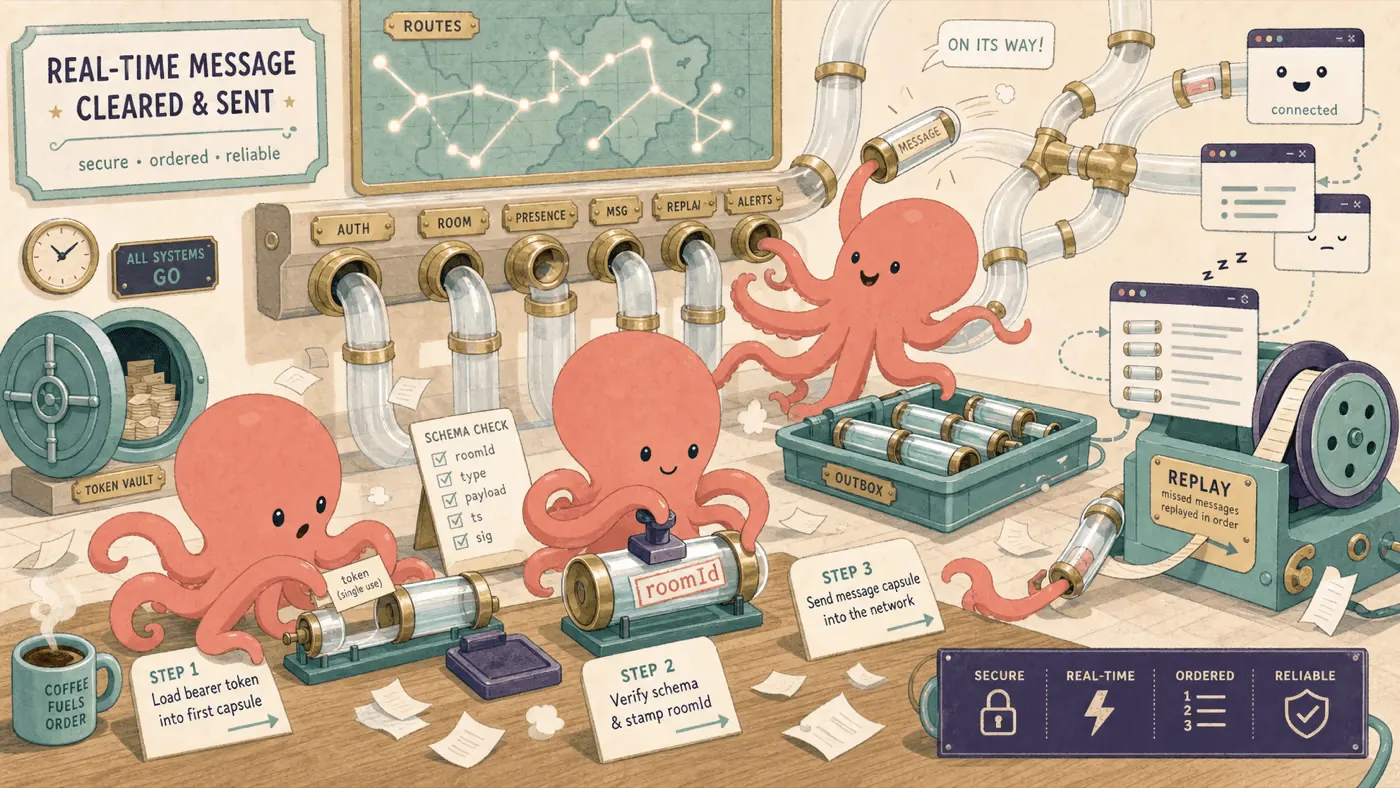
Typed WebSocket Channels in TypeScript: Params, Auth, and Live Pub/Sub
WebSocket code usually starts clean and then quietly splits into several little protocols: one for route params, one for auth, one for publish payloads, one for reconnects, and one for whatever the browser cannot express in new WebSocket().
Tako channels try to make the live part feel like one model. You define a channel once, and Tako turns that definition into the public route, the param validator, the auth callback, the publish type, and the browser transport.
Durability is part of the channel contract, but it is scoped to delivery. Every publish is written to a bounded replay log before fanout, so reconnecting clients can catch up after short disconnects without turning the channel into your app’s permanent history API.
The channel is the contract
A JavaScript or TypeScript channel is a default export from src/channels/*.ts by default. The first argument is the wire name, paramsSchema is a TypeBox schema, auth.verify decides access, and the presence of handler selects bidirectional WebSocket transport.
// src/channels/presence.ts
import { defineChannel } from "tako.sh";

type PresenceMessages = {
  cursor: { x: number; y: number; userId: string };
  typing: { userId: string };
};

export default defineChannel("presence", {
  paramsSchema: (t) => t.Object({ roomId: t.String({ minLength: 1 }) }),
  auth: {
    headerName: "authorization",
    async verify({ header, params, operation }) {
      const session = await readSession(header);
      if (!session) return false;
      return canAccessRoom(session.userId, params.roomId, operation)
        ? { subject: session.userId }
        : false;
    },
  },
  handler: {
    cursor: (data) => data,
    typing: (data) => data,
  },
}).$messageTypes<PresenceMessages>();
TypeBox matters here because it gives Tako both sides of the shape. Per the TypeBox docs, a schema is a JSON Schema object that can also infer a TypeScript type. Tako uses that JSON Schema to validate /_tako/channels/presence?roomId=lobby before asking your app to authorize anything, while TypeScript uses the same declaration to type params.roomId in your callback.
No handler means receive-only SSE. A handler declaration selects WebSocket, and the current v0 proxy stores and broadcasts client { type, data } frames as sent. App-side handler callbacks are not yet part of the deployed dispatch path. See the Channels reference for the current contract.
Auth happens before messages
For normal SSE requests, auth can ride in headers or cookies. Browser WebSockets are trickier because the constructor does not let client code set arbitrary headers. Tako handles that with a first text frame:
{ "type": "tako.auth", "token": "Bearer abc" }If a channel requires header auth and the WebSocket upgrade did not include that header, the proxy waits briefly for this frame. It parses the token as the declared header value, asks your app’s verify callback through POST /channels/authorize, and only then starts accepting publish frames.
That keeps auth in one place: your callback receives { header, cookie, params, channel, operation }, and operation tells you whether the request is subscribing or connecting. Cookie-only auth still works too; set headerName: false and cookieName in the channel definition.

Publish and reconnect
Server-side publish is just an import. Parameterized channels are callable, so binding params and publishing a typed message are the same motion:
import presence from "../channels/presence";

await presence({ roomId: "lobby" }).publish({
  type: "typing",
  data: { userId: "u_123" },
});
The .$messageTypes<PresenceMessages>() call is type-only, but it is enough for TypeScript to reject the wrong message type or payload shape. At runtime, the proxy stores each publish in the bounded replay log and fans it out to subscribers.
Browser clients should reconnect automatically after network loss, laptop sleep, or server restarts. Tako Channels reconnect with the last received message id and replay what is still inside the channel’s retention window.
That window is intentionally short by default: 10 minutes.
Store canonical history in your app
Channel replay is for delivery continuity, not product history. If the event is part of your app’s source of truth, write it through a normal authenticated app endpoint, then publish the saved value from server-side code:
import chat from "../channels/chat";

const message = await db.messages.insert({ roomId, text, userId });
await chat({ roomId }).publish({ type: "msg", data: message });
That keeps the TypeScript surface small: one channel primitive for WebSocket/SSE delivery, with app storage used when messages need to outlive the reconnect window.